
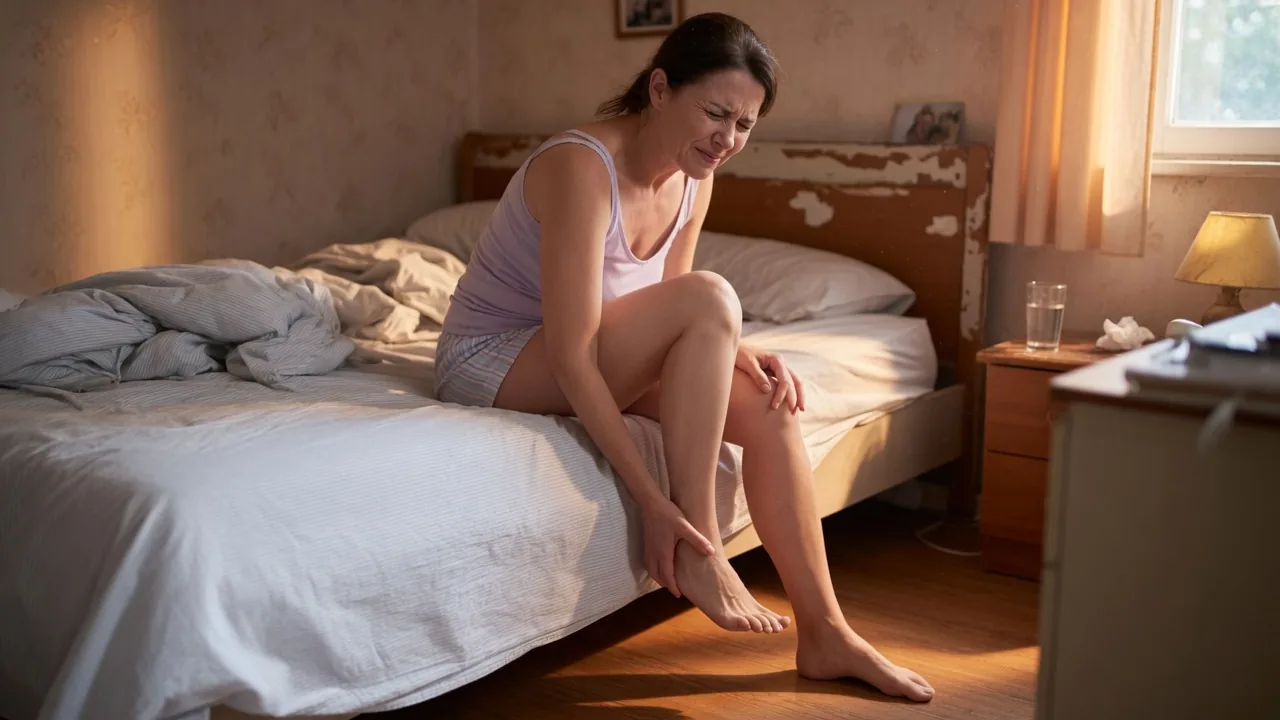
You know the one. You swing your legs out of bed, put your feet down, and the first few steps feel like standing on a bruise or a drawing pin under the heel. By the time you've shuffled to the kettle it's eased off — until you sit for a while, get up, and it bites again. It's one of the most common things I see, and it has a name: plantar fasciopathy (you might know it as plantar fasciitis).
The good news is it's very treatable. The slightly less welcome news is that the quick fixes people reach for usually aren't the thing that sorts it.
What's going on down there
The plantar fascia is a thick band of tissue that runs along the sole of your foot and helps support your arch. When it gets overloaded — a spike in walking or running, a lot of standing, a change of shoes, or extra weight going through it — it gets irritated near where it attaches to the heel. That's what's firing on those first morning steps: overnight the tissue tightens up, so the first load of the day hits it hard.
What actually helps
Here's where the evidence is really clear: the foundation of getting better is exercise-based, not a gadget. The current clinical guidelines put stretching and strengthening front and centre:
- Stretching the plantar fascia and calf — this reliably reduces pain in both the short and longer term
- Loading and strengthening to build the tissue's tolerance back up
- Taping for short-term relief while you get going
- Load management — easing the spike that set it off, then rebuilding gradually
Supportive footwear and an orthotic can absolutely help — especially for settling the pain and supporting the arch — but they work best as part of that plan rather than as a standalone fix.
Sick of that first-step pain? We treat plantar heel pain across South East Queensland — Caboolture, Beenleigh, Browns Plains and Victoria Point.
Book an appointmentWhy it's worth getting on top of early
Plantar heel pain tends to reward people who tackle it properly and early, and drag on for those who wait and hope. A proper assessment sorts out what's overloading the fascia in the first place — footwear, a training spike, or the way your foot loads — and turns that into a clear plan. If you're a runner or on your feet all day, a biomechanical assessment often reveals the driver, and we'll help you settle the pain enough to get the rehab done. It's rarely a quick fix, but with the right approach it genuinely gets better.
Common questions about heel pain
Why is it worse in the morning?
The fascia tightens overnight, so the first steps load it suddenly — that first-step pain is the hallmark of plantar fasciopathy.
How long does it take to heal?
Usually a few months, and most people improve well with the right exercise-based plan.
Do stretches help?
Yes — plantar fascia and calf stretching plus strengthening is the foundation of care and gives short- and long-term relief.
Do I need orthotics?
They can help as part of a plan, especially for settling pain, but work best alongside stretching, strengthening and load management.
Let's get you walking pain-free again. We'll find what's driving it and build a plan that actually settles it. Clinics at Caboolture, Beenleigh, Browns Plains and Victoria Point.
Book an appointmentReferences & further reading
- Koc TA, et al. Heel Pain — Plantar Fasciitis: Revision 2023 Clinical Practice Guidelines. Journal of Orthopaedic & Sports Physical Therapy.
- Better Health Channel (Victorian Government) — Foot problems — heel pain.
- healthdirect (Australian Government) — Foot care.
This is general information, not individual advice. If your heel pain is persistent, please see a podiatrist so it can be assessed properly.