
It usually happens in a split second. You land funny after a jump, step off a gutter you didn't see, or roll off the edge of your shoe on the netball court. There's that sickening moment where your ankle goes one way and you go the other — and then the swelling starts.
Most people do the same thing next: hobble home, prop it up with a bag of frozen peas, and hope it'll come good on its own. Sometimes it does. But a fortnight later, plenty of those ankles are still puffy, still sore, and still not trusted on a set of stairs — and that's usually because of what didn't happen in the days after.
So let's talk about what actually gets you back on your feet.
First, what you've actually done
When you "roll" your ankle, you've almost always stretched or torn one or more of the ligaments on the outside of the ankle — the tough bands that hold the joint together. That's a sprain. It can range from a mild overstretch to a fuller tear, which is why some settle in a week and others hang around for months.
The pain, swelling and bruising you get are all part of the body's normal response to that injury. None of it means you've "broken" anything — but it does mean the joint needs the right kind of help to knit back together properly.
The old advice has changed — and it matters
If you grew up with "R.I.C.E." (rest, ice, compression, elevation) and the idea that you should stay off it completely, here's the update: resting it completely is no longer the goal. The thinking has shifted to POLICE — Protection, Optimal Loading, Ice, Compression, Elevation.
The important words there are optimal loading — gentle, controlled movement and weight-bearing as soon as it's comfortable enough, rather than parking yourself on the couch for a week. Within sensible limits, moving the joint early helps it heal and keeps it from stiffening up. Completely babying it tends to leave you weaker and slower to recover.
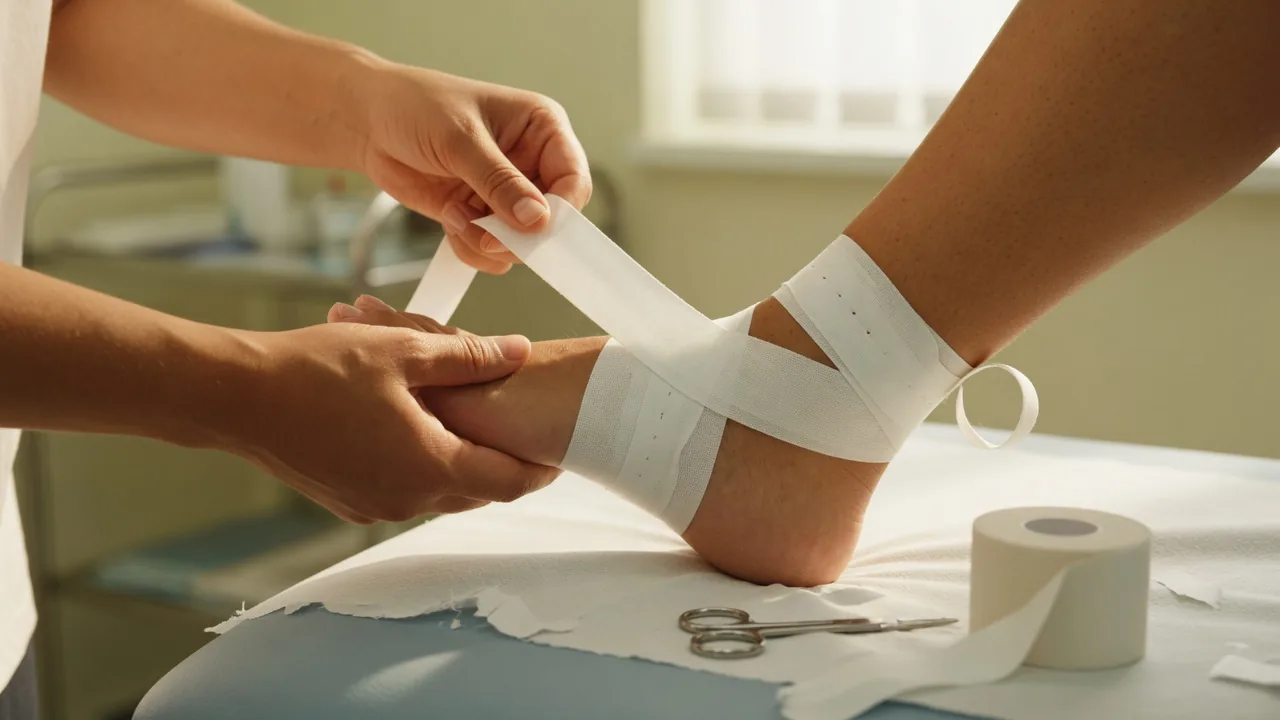
What the first 48 hours should look like
In those first couple of days, the aim is to settle the swelling and protect the joint without shutting it down:
- Protect it — supportive strapping or a brace, and use it within comfortable limits
- Load it gently — put a bit of weight through it as pain allows, rather than avoiding it entirely
- Ice — around 15 minutes every couple of hours for the first day or two
- Compress — a firm (not tight) bandage to help control swelling
- Elevate — up above heart height whenever you can
And a quick "don't": in the first 48 hours, steer clear of heat, alcohol, running and vigorous massage — they tend to increase the swelling rather than help it.
The step most people skip (and later regret)
Here's the part I wish more people knew. The reason an ankle so often "never feels the same" isn't the original sprain — it's that once the pain eases, most people stop there. They never rebuild the strength and balance the injury quietly knocked out.
A sprain dulls the ankle's sense of where it is in space (its balance sense), and leaves the surrounding muscles a bit weaker. If you don't retrain those, the ankle stays vulnerable — and rolls again more easily next time. That's exactly why some people end up spraining the same ankle over and over. A structured rehab plan — balance work, strengthening, and a gradual return to your sport — is what genuinely rebuilds stability, and it's a big part of what we help with. If your sprain happened running or you're getting back into it, a running and biomechanical assessment helps us see what set it up in the first place.
Ankle still not right? We assess and rehab ankle sprains across South East Queensland — Caboolture, Beenleigh, Browns Plains and Victoria Point.
Book an appointmentWhen to get it looked at
Most sprains can be managed well without a scan, but it's worth getting the ankle assessed if:
- You can't put weight on it or take more than a few steps
- There's a lot of bruising, or the ankle looks out of shape
- It's very tender over the bone itself (worth ruling out a fracture)
- It's been a couple of weeks and it's just not improving
- This is the third or fourth time you've done the same ankle
A quick assessment sorts out whether you need imaging, what stage of loading you're up to, and how to get back to sport without re-injuring it. It's also where ongoing pain or a stubbornly weak ankle gets properly addressed rather than left to chance.
Common questions I get about ankle sprains
How long does a sprained ankle take to heal?
Most settle over about four to six weeks, though a bad one can take longer, and full strength and confidence can take a few months. Starting sensible movement and rehab early usually speeds it up.
Should I rest it or move it?
Move it — within comfortable limits. Complete rest is out of date; gentle, protected movement and weight-bearing help it heal rather than stiffen.
Do I need a scan or X-ray?
Not always. If you can't weight-bear or take a few steps, or there's bony tenderness, get it assessed to rule out a fracture — imaging only if it's actually needed.
Why does my ankle keep rolling?
A sprain leaves the ankle weaker and its balance sense blunted, so it rolls more easily. Balance and strength rehab is what rebuilds stability and cuts the chance of it happening again.
Want it done properly this time? We'll check the ankle, get you moving safely, and build the rehab that stops it happening again. Clinics at Caboolture, Beenleigh, Browns Plains and Victoria Point.
Book an appointmentReferences & further reading
- healthdirect (Australian Government) — Sprained ankle: symptoms, causes and treatment.
- Better Health Channel (Victorian Government) — Ankle sprains.
- Journal of Orthopaedic & Sports Physical Therapy — Ankle Sprains: What Updated Guidelines Mean for You (2021).
- Martin RL, et al. Ankle Stability and Movement Coordination Impairments: Lateral Ankle Ligament Sprains (Revision 2021). JOSPT Clinical Practice Guidelines.
This is general information, not individual advice. If you've hurt your ankle, please see a podiatrist or other health professional so it can be assessed properly.